




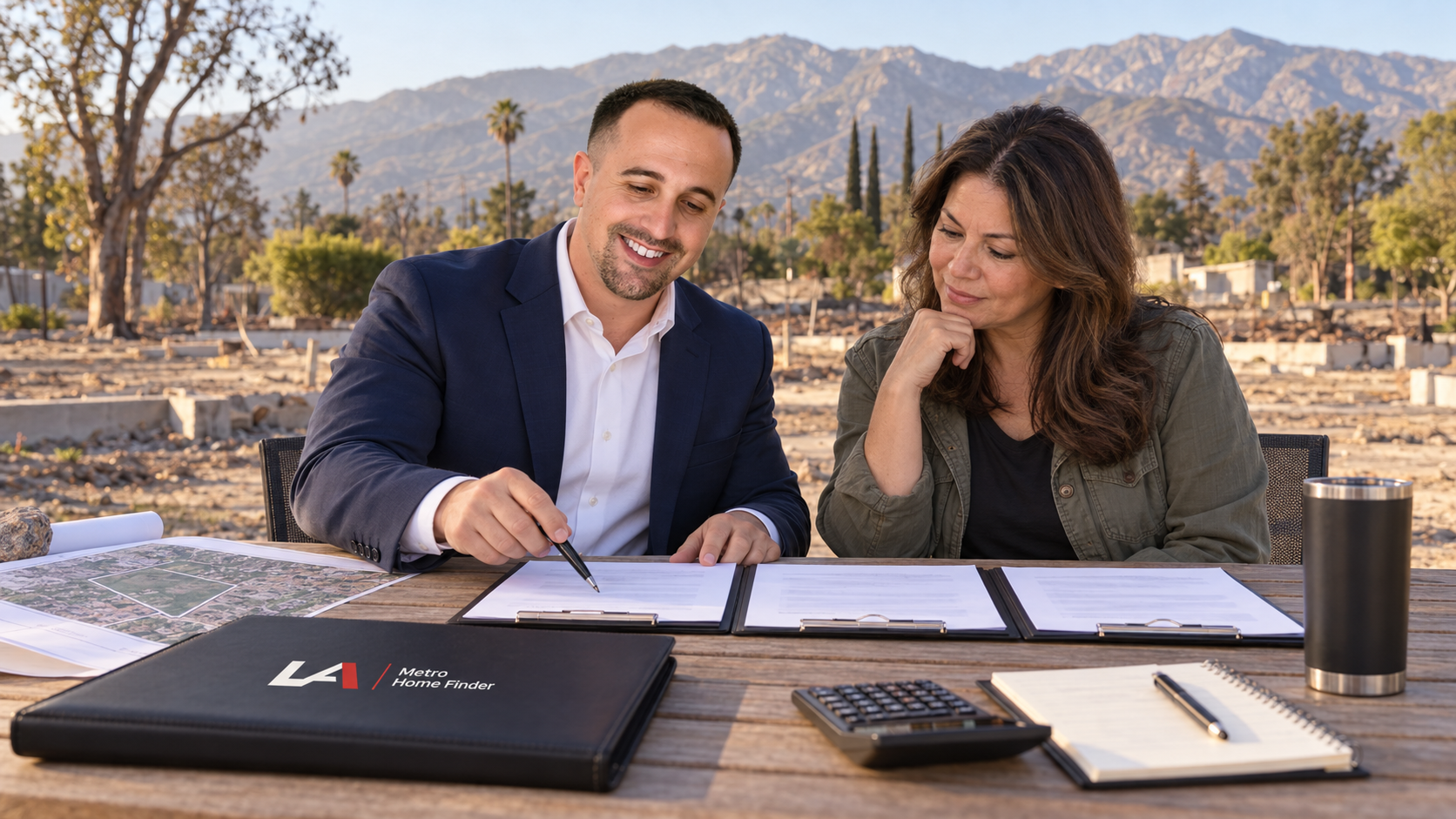
Altadena Fire-Lot Seller Guide
Should I Accept a Builder, Investor, or Owner-User Offer for My Altadena Fire Lot?
A builder, investor, and future owner-user may approach the same Altadena parcel in Los Angeles County with different plans. Those plans can change what records they request, which professionals need access, how they finance the purchase, and which permit or utility questions matter to them. They do not prove who will pay more, close faster, waive more protections, or perform more reliably.
The California Department of Real Estate tells consumers to evaluate offers carefully, understand the terms before accepting, and obtain professional advice when contract language is not understood. An accepted offer can become a binding contract. That makes the actual written terms more important than a buyer category or a verbal promise. (California DRE, Information for Homebuyers, accessed October 10, 2026)
Start with a parcel-specific offer comparison and estimated-net review.
What Does Each Buyer Label Actually Tell You?
For an Altadena parcel in Los Angeles County, a buyer label tells you the stated purpose or business model, not whether the buyer will complete the transaction. A builder may want to construct and resell. An investor may plan to hold, develop, assign, partner, or resell. An owner-user may plan to rebuild a personal residence. Each description is only a starting question.
| Buyer description | Questions to verify | Evidence that matters | What the label does not prove |
|---|---|---|---|
| Builder | Who is the purchasing entity, what project is contemplated, and which site records or access are requested? | Executed offer, entity documents, funding or lender evidence, requested investigation scope, title and escrow instructions | Price, speed, reliability, permit eligibility, or absence of contingencies |
| Investor | Will the buyer hold, develop, partner, assign, or resell, and does the written offer allow the contemplated structure? | Buyer identity, proof of funds or financing, assignment and vesting terms, decision authority, closing evidence | Cash certainty, waiver of diligence, minimum discount, or closing performance |
| Owner-user | How will the buyer fund acquisition and rebuilding, and which appraisal, insurance, permit, and utility questions affect the offer? | Lender review when applicable, funds evidence, appraisal and insurance path, written investigation terms | Higher price, emotional commitment, financing approval, or willingness to absorb unknowns |
Ask every buyer for the evidence appropriate to that buyer's actual structure. Do not assume the individual signing the offer personally controls the funds, that an entity name proves a development history, or that a planned use has County approval. Title, escrow, the buyer's lender, counsel, and other professionals may need to verify different parts of the file.
See current Altadena land inventory for context, then compare your actual offers on their own terms.
The decision anchor is one evidence sheet for every buyer, not a different standard for each buyer label.
How Should You Verify the Buyer and Funding?
Start by confirming who is buying, who has authority to sign, how title is proposed to vest, and whether the buyer expects to assign the agreement or add another entity. These are not reasons to reject an offer. They are facts to reconcile with the offer, title, escrow, and professional advice before treating the buyer name as settled.
For an offer represented as cash, review the current proof of funds and ask the appropriate transaction professionals whether the evidence supports the amount and timing required by the written offer. Cash does not eliminate title issues, escrow requirements, entity questions, assignment terms, property investigation, insurance needs, or the possibility that a buyer fails to perform.
For a financed offer, look beyond a generic preapproval label. Ask what the lender has reviewed, which property information remains outstanding, whether appraisal or insurability matters, whether acquisition and construction are separate, and what written financing conditions remain. The buyer's lender decides lending matters. The appraiser decides the appraisal analysis. The insurer decides coverage and eligibility.
- Exact buyer and proposed vesting
- Signing authority for any entity
- Current proof of funds
- Written lender review when applicable
- Source and timing of required funds
- Assignment or substitution language
- Escrow and title requirements
- Any third-party approval still required
The California DRE's homebuyer guidance explains that financing, property condition, inspections, title, and other contingencies belong in the buyer's offer and review process. It is general education rather than current form language. Use the executed offer and current professional review for this transaction. (California DRE First-Time Home Buyers guidance, accessed October 12, 2026)
Put the buyer identity and funding evidence next to the written offer before you rank it.
Call (626) 240-1750The funding anchor is evidence adequate for the offer's actual purchase structure, not a label such as cash, builder, investor, or owner-user.
Which Offer Terms Deserve a Side-by-Side Review?
Price is one line. The rest of the offer tells you what must happen before the transaction can close and who bears each cost or uncertainty. Read the entire contract package, including counteroffers, addenda, disclosures, and later signed modifications. Do not borrow a deadline, cancellation rule, deposit conclusion, or contingency meaning from an online article or another transaction.
| Offer term | Seller comparison question | Evidence or professional |
|---|---|---|
| Price and credits | What is offered, what seller costs or credits are requested, and which allocations affect the estimated net? | Executed offer, escrow estimate, broker review |
| Deposit | What do the written terms require, when, and under what actual conditions? | Contract, escrow instructions, broker and counsel when needed |
| Property investigation | What site, debris, soil, foundation, environmental, utility, survey, permit, and access work is requested? | Written terms, access plan, qualified professionals and agencies |
| Financing and appraisal | Which loan, funding, appraisal, or completed-value dependencies remain? | Lender evidence, funds evidence, appraisal process, written offer |
| Title and assignment | Which exceptions, easements, access rights, entity, vesting, or assignment issues must be resolved? | Preliminary title report, underlying documents, title, escrow, surveyor and counsel |
| Closing and possession | What events must occur before closing, and what seller access, removal, occupancy, or delivery duties are stated? | Contract calendar, escrow, broker, counsel when needed |
The DRE's January 2025 Los Angeles wildfire consumer alert advised property owners to take time to evaluate offers, choose a buyer that meets the seller's financial needs, and consider help from a real-estate agent and/or attorney. Those durable principles support a careful written comparison. This article does not assume every emergency restriction discussed in that alert remains operative in October 2026. (California DRE wildfire consumer alert, January 17, 2025)
Have two or more offers? Build one normalized comparison before responding.
Text ALTADENA COMPAREThe contract anchor is the complete executed document set, not a generic expectation about how a buyer category behaves.
How Do Altadena Recovery Questions Affect an Offer?
An Altadena fire-lot buyer may care about the former legal structure, debris and clearance records, remaining foundation or site conditions, current planning standards, access, utilities, insurance, and the intended rebuilding path. A seller should organize available records and accurately describe what is known, unknown, requested, or still controlled by an agency or professional.
LA County Planning describes the current like-for-like path and explains that work outside that path is subject to current standards, including the Altadena Community Standards District and the West San Gabriel Valley Area Plan. The County's public framework does not approve a buyer's project or prove that a parcel qualifies for a specific path. (LA County Planning, Eaton Fire recovery, accessed October 10, 2026)
LA County's like-for-like page describes site clearance, plan submission, permits, construction inspections, and certificate of occupancy. It also states that required debris-removal phases must be complete before permit issuance. That supports collecting parcel-specific clearance and permit records, not promising buildability or a completion date. (LA County Recovers, Like-for-Like Rebuild, accessed October 10, 2026)
Transfer questions need particular care. LA County expressly says its qualifying fire-rebuild fee deferral is non-transferable. A prior owner's personal fee treatment should not be marketed as a benefit that automatically passes to the buyer. Plans, permits, former-footprint evidence, insurance proceeds, utility status, and other recovery items also need current parcel-specific review before either side relies on them. (LA County Recovers, Fee Deferrals and Refunds, accessed October 10, 2026)
Insurance can affect an owner-user, investor, or builder in different ways, but the buyer label still does not determine availability. The California Department of Insurance advises consumers to shop the traditional market and describes the FAIR Plan as a last-resort source of basic property coverage with limited perils. Eligibility, coverage, exclusions, price, lender acceptance, construction coverage, and supplemental coverage require current property-specific review. (California Department of Insurance residential resources, accessed October 10, 2026)
Organize the parcel records before the next counteroffer or buyer access request.
Request a parcel and value reviewThe recovery anchor is a dated parcel file and written agency or professional evidence, never an automatic transfer assumption.
How Do You Compare Estimated Net Proceeds?
For an Altadena fire-lot sale in Los Angeles County, an offer with the highest headline price may not produce the highest estimated seller net. Requested credits, seller-paid costs, title and escrow items, liens or agreed payoffs, taxes or withholding, commissions or compensation, repair or clearance obligations, personal-property terms, and other transaction-specific items can change the estimate.
Build the comparison from current inputs supplied by the actual transaction professionals. Justin can coordinate the worksheet. Escrow and title can provide transaction estimates within their roles. A tax adviser should address tax treatment. An attorney should address disputed rights, custom drafting, or legal interpretation. Do not present a preliminary worksheet as a guaranteed final settlement statement.
| Worksheet line | Offer A | Offer B | Offer C | Source |
|---|---|---|---|---|
| Written price | Enter from offer | Enter from offer | Enter from offer | Executed offer |
| Requested seller credits or concessions | Enter actual term | Enter actual term | Enter actual term | Offer and counteroffer |
| Estimated seller transaction costs | Current estimate | Current estimate | Current estimate | Broker, escrow and title inputs |
| Liens, agreed payoffs or other adjustments | Evidence pending or current estimate | Evidence pending or current estimate | Evidence pending or current estimate | Title, escrow and seller records |
| Estimated net | Recalculate | Recalculate | Recalculate | Current worksheet, not a guarantee |
| Open execution risks | List unresolved terms | List unresolved terms | List unresolved terms | Offer matrix and professional review |
Ask for a side-by-side estimated-net review using your current written offers.
The net anchor is a dated worksheet that shows every source, assumption, unresolved amount, and negotiated change.
What Is a Practical Seller Offer-Comparison Workflow?
- Preserve the exact offer package. Keep the offer, addenda, disclosures, proof of funds, lender material, entity information, and communications together.
- Normalize the financial terms. Put written price, requested seller costs, credits, concessions, and estimated transaction expenses into the same worksheet.
- Verify buyer identity and funding. Reconcile signers, entities, vesting, assignment questions, funds, and lender dependencies with title, escrow, and the appropriate professionals.
- Map every contingency and investigation request. Record property, title, survey, permit, utility, financing, appraisal, insurance, and access dependencies exactly as written.
- Separate parcel evidence from buyer assumptions. Organize existing records, mark missing evidence, and route conclusions to LA County or the licensed professional responsible.
- Calculate estimated net. Use current inputs, label unknown amounts, and avoid treating a preliminary estimate as final proceeds.
- Identify execution risk. Note unresolved conditions, third-party decisions, document requests, access needs, and events that could lead to delay, renegotiation, or failure to close.
- Review before accepting or countering. Use the broker, escrow, title, attorney, tax adviser, lender, insurer, appraiser, engineer, or contractor whose role matches the open question.
An Altadena seller in Los Angeles County can then compare the offers on one consistent record instead of switching standards because one buyer calls itself a builder and another says it plans to live on the property. If a material term changes, update the worksheet and decision record before relying on the earlier ranking.
Use the same evidence sheet for every written offer and every counteroffer.
Text ALTADENA NETThe workflow anchor is one controlled comparison record that changes whenever the written terms or supporting evidence changes.
Which Offer-Review Shortcuts Create Risk?
- Ranking offers only by headline price
- Treating cash as guaranteed performance
- Assuming a builder has County approval
- Assuming an owner-user will ignore parcel risk
- Relying on verbal waiver or timing promises
- Treating a deposit as automatically nonrefundable
- Ignoring entity, assignment, or vesting terms
- Marketing fee relief or recovery benefits as transferable
- Using portal asking prices as closed-sale proof
- Leaving unknown seller costs at zero
For an Altadena fire lot in Los Angeles County, a listed price, buyer statement, portal profile, contractor name, lender logo, or proposed plan is not proof of value, motivation, ownership, financing, permit status, insurance, utility service, or a closed sale. Verify the exact fact through the source responsible for it.
If an offer looks simple because of its label, test the evidence before you accept it.
Call (626) 240-1750The red-flag anchor is any claim that asks you to replace written evidence with a buyer category, a portal description, or an automatic transfer assumption.
Which Official Sources Should You Recheck?
- California DRE Information for Homebuyers for offer, contingency, binding-contract, and professional-review principles
- California DRE publications for official consumer and real-estate reference materials
- California DRE Los Angeles wildfire consumer alert for durable offer-evaluation guidance, not a claim that every emergency restriction remains operative
- LA County Planning Eaton Fire recovery and LA County like-for-like guidance for current recovery-path questions
- LA County fee deferrals and refunds for the express non-transferability of qualifying fee deferral
- California Department of Insurance residential resources for current insurance-shopping and FAIR Plan context
Re-open the current government pages before accepting an offer when a material term depends on agency policy, parcel status, insurance, or recovery-program treatment. Public programs and procedures can change.
Frequently Asked Questions
Is a builder offer automatically better for an Altadena fire lot?
No. A builder label does not establish price, funding, investigation scope, closing ability, assignment rights, contingencies, or estimated seller net. Compare the complete written offer and verify each material term with the appropriate broker, escrow, title, lender, attorney, tax adviser, or other professional.
Is a cash investor offer safer than a financed owner-user offer?
Not automatically. Cash removes a loan dependency only when the written offer actually has no financing condition and the buyer's funds are properly verified. Cash does not eliminate title, access, entity, assignment, investigation, insurance, permit, utility, or closing risks.
What should an Altadena fire-lot seller compare besides price?
Compare verified funds or financing, deposit terms as written, investigation and other contingencies, requested records and access, title and assignment terms, concessions, closing requirements, unresolved parcel dependencies, and an estimated net prepared from current transaction inputs.
Do the prior owner's Altadena rebuild benefits automatically transfer to a buyer?
No blanket transfer assumption is safe. LA County expressly describes its qualifying fire-rebuild fee deferral as non-transferable. Any claimed permit path, former baseline, plan, utility status, insurance benefit, fee treatment, or other recovery benefit needs current parcel-specific confirmation from the responsible authority and professional.
Can an earnest-money deposit be treated as automatically nonrefundable?
No. Deposit handling, notices, contingency removal, remedies, cancellation rights, and release of funds depend on the executed contract, facts, escrow instructions, and applicable law. The seller should review the actual terms with the licensed real-estate professionals and obtain California legal advice when needed.
How can Justin Borges help compare Altadena fire-lot offers?
Justin can coordinate listing strategy, buyer and funding evidence, seller-document requests, parcel access, offer comparison, estimated-net inputs, and title or escrow follow-up. Attorneys, tax advisers, lenders, appraisers, insurers, agencies, engineers, contractors, title, and escrow decide within their professional roles. Call or text (626) 240-1750.

About Justin Borges
Justin Borges has closed $200M+ in career sales with a 106% average list-to-sale ratio and has held an active California DRE salesperson license since October 2013, CA DRE #01940318. For Altadena fire-lot sellers, he coordinates listing strategy, parcel evidence, buyer and funding verification, access, offer comparison, estimated-net inputs, and title or escrow follow-up.
Justin is not acting as an attorney, tax adviser, lender, appraiser, insurer, planner, engineer, contractor, title officer, or escrow officer. Those professionals and agencies provide conclusions within their authority.
Compare the written terms and estimated net before deciding which Altadena offer fits your goals.
Start an Altadena offer review