



Altadena fire-lot law and parcel guide
Can SB 9 or an ADU Work on an Altadena Fire Lot?
Possibly, but SB 1090 did not create blanket approval and did not pause every SB 9 or accessory dwelling unit project in Altadena. The enacted law took effect October 1, 2026 and created a three-year Altadena moratorium on SB 1123 specifically. SB 9, ADU and like-for-like rebuild questions remain separate, parcel-specific paths that require current County and professional confirmation. (California Senate District 25, September 30, 2026) The chaptered text controls. (California Legislature, SB 1090, 2026)
Start with the parcel, not a promised unit count.
What Did SB 1090 Actually Change in Altadena?
SB 1090 was signed on September 30, 2026 and took effect the next day because it carried an urgency clause. The official announcement from the bill author's office describes a three-year moratorium on SB 1123 specifically in Altadena. It separately says the law preserves the ability to pursue ADUs or split lots. That distinction matters because earlier versions and older articles described a broader or longer pause. Those earlier descriptions are stale. (California Senate District 25, September 30, 2026)
The Governor's official legislative update confirms that SB 1090 was signed and identifies its subject as planning, urban lot splits and Altadena. The chaptered law controls. Before anyone relies on an exception, prior application, timing argument or expiration provision, qualified counsel and the reviewing agency should examine the current chaptered text and the exact record. (Office of Governor Gavin Newsom, September 30, 2026)
SB 1090 also does not make a development idea part of a property's value automatically. A seller's concept plan, listing language, prior consultation, nearby construction or online portal result can help frame questions. None is a substitute for the current parcel record, current law and a project-specific agency response.
Need help separating the real-estate file from the legal and design questions?
Call (626) 240-1750Which Altadena Path Are You Really Evaluating?
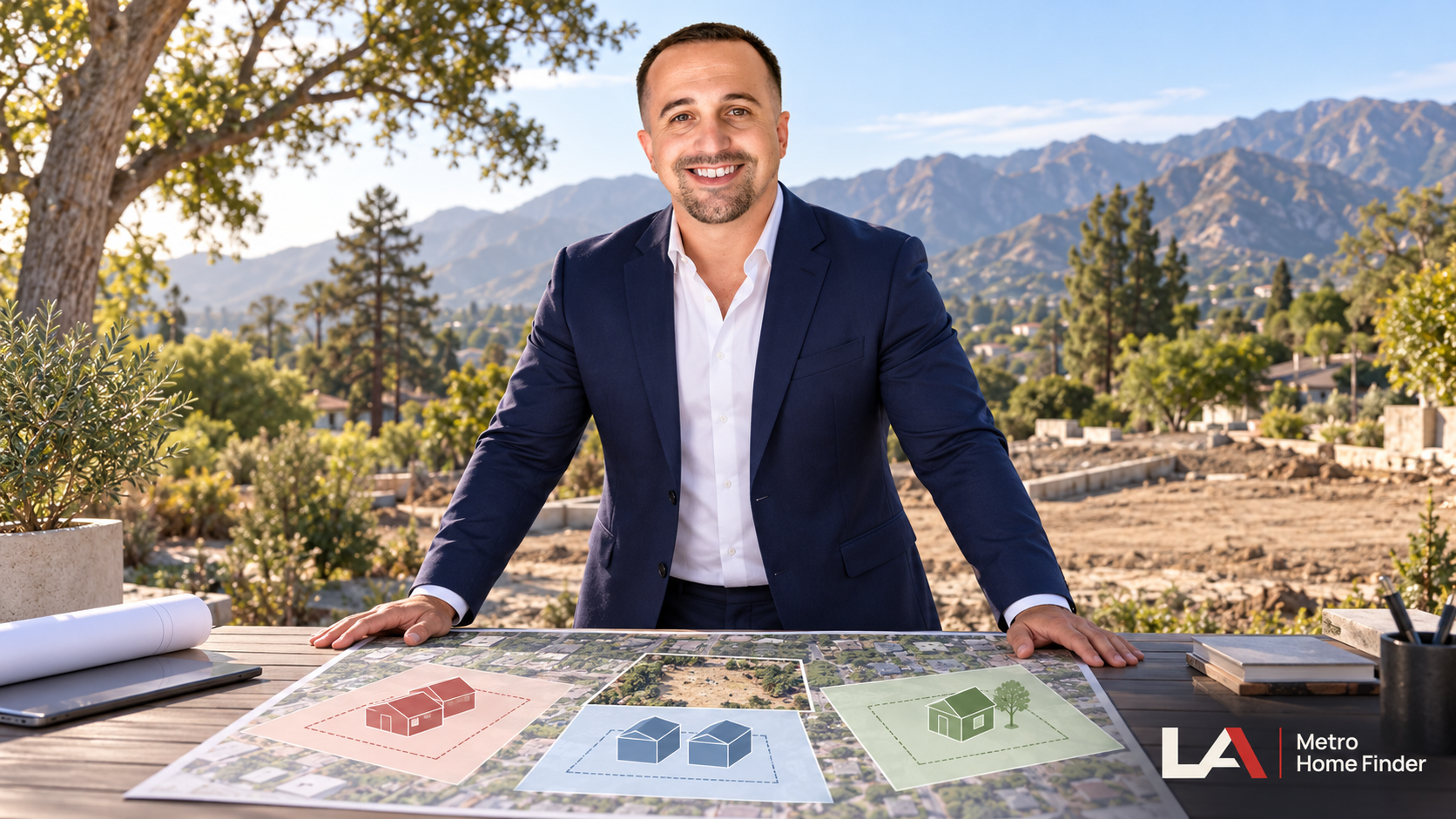
“Can I add units?” is too broad to answer safely. The useful question is which approval path, for which parcel, using which existing records and proposed plan. Keep these files separate until the appropriate agencies and professionals connect them. (LA County Planning, October 2026)
| Path | What it asks | What it does not prove | Starting evidence |
|---|---|---|---|
| Like-for-like rebuild | Whether a destroyed structure can use the County's recovery treatment based on its lawful pre-fire baseline and current requirements. | It does not prove SB 9, ADU or subdivision eligibility. | Pre-fire records, scope, site status, current County recovery guidance and agency responses. |
| Different rebuild | Whether a revised home or site plan can move through current planning, building, fire and other review. | It does not inherit every benefit or determination connected to the prior structure. | Zoning, title, survey, hazard information, design concept, utilities, access and current review path. |
| ADU or JADU | Whether a qualifying accessory unit can be proposed under current state and County rules with the primary-residence plan. | It does not follow automatically from a listing, neighbor's project or old concept. | Current County ADU guidance, HCD guidance, parcel facts, site plan and reviewing-agency answers. |
| SB 9 | Whether the exact parcel and proposal fit the current County process for qualifying development or an urban lot split. | A lot-split path does not itself approve future structures, utilities or financing. | County SB 9 materials, parcel and title records, map and survey work, hazard review and professional analysis. |
| SB 1123 | Whether a proposed subdivision falls within the pathway affected by SB 1090 and whether timing or an exception matters. | It should not be relabeled as ordinary SB 9 or an ADU path. | Current chaptered law, application history, counsel, County confirmation and complete parcel records. |
LA County's like-for-like page says current codes and required agency review still matter. LA County's SB 9 page identifies zoning, hazard, mapping and other constraints. Its ADU page and California HCD's current ADU Handbook provide separate starting points. A responsible analysis reconciles those sources rather than borrowing the easiest sentence from any one page. (LA County Planning, October 2026)
Get a checklist organized around the path you are actually considering.
Text for the path checklistWhat Must Be Verified for an Exact Los Angeles County Fire Lot?
The first meaningful deliverable is not a yield estimate. It is a parcel evidence file. The file should let County staff, counsel, the surveyor, design professionals, utility providers, lender and insurer answer the same project question using the same facts. (County of Los Angeles, October 2026)
Jurisdiction and baseline
Confirm that the parcel is in unincorporated Altadena and identify the current zoning and lawful pre-fire baseline. Record the APN, legal description, ownership, existing liens and easements, prior structures, permit history, debris status and any open cases. Do not assume that an Altadena mailing address answers the jurisdiction question.
Hazards, site and mapping
Obtain the current hazard, fire, slope, access, geotechnical, drainage, tree, environmental and site-clearance facts that apply to the proposed path. An urban lot split, an accessory unit and a home rebuild can create different mapping and site questions. A County planning response does not replace building, fire, public health, public works or other required review.
Utilities and access
Confirm the actual water provider, meter and lateral status, sewer or septic facts, electrical service and panel status, gas conditions, telecom access, easements, fire-flow questions and connection requirements for the exact parcel and plan. Visible lines, neighboring service or a portal statement do not prove capacity, account status, connection cost or approval.
Applications and timing
Ask for the complete application history, not just a screenshot or case number. Identify what was filed, by whom, under which pathway, on what date, whether it was complete, whether it remains active, and what the agency says it means after SB 1090. Counsel should evaluate any claimed exception, grandfathering theory or vested right.
Transfer-sensitive benefits
Separate the land and entitlement record from insurance proceeds, lender arrangements, fee programs, tax treatment, temporary housing, recovery deadlines and other owner-specific benefits. Do not assume that a buyer receives a benefit because a prior owner or destroyed structure once qualified.
- APN and legal description
- Jurisdiction and zoning
- Title, liens and easements
- Pre-fire permit baseline
- Current debris and site status
- Hazard and fire review
- Survey and mapping needs
- Access and driveway facts
- Water provider and service record
- Sewer or septic record
- Electrical and gas status
- Application and correction history
- Proposed plan and use
- County and agency contacts
- Lender and insurer conditions
- Professional written opinions
Bring one parcel and one proposed path to a focused Altadena consultation.
Call (626) 240-1750How Should a California Buyer Structure Due Diligence?
A buyer should treat hoped-for development potential as an unresolved condition until the required professionals and agencies provide usable evidence. The offer, deposit, investigation period, document requests, access rights and closing schedule should leave enough room for the buyer's actual review team to work. Form selection and cancellation rights are legal questions; obtain qualified legal advice rather than relying on generic internet language. (County of Los Angeles, October 2026)
- Name the intended path. State the rebuild, ADU, SB 9 or other question clearly enough that each professional is evaluating the same concept.
- Request the complete seller file. Ask for permits, plans, surveys, utility records, applications, agency correspondence, insurance-related property records and known notices, subject to appropriate legal guidance.
- Verify independently. Match seller materials to live public records and direct provider responses. Do not infer current status from an old approval or portal.
- Coordinate the review team. County staff, counsel, surveyor, architect or designer, engineer, utility providers, lender and insurer each answer different parts of the decision.
- Model more than one outcome. Evaluate the purchase without depending on the desired development path. Do not treat projected rent or resale value as assured.
- Document unresolved items. Track who must answer each question, what evidence is needed, and whether it can be obtained before the relevant transaction deadline.
Financing and insurance deserve early attention. A lender's willingness to finance land, construction or an accessory unit depends on its program, collateral analysis, borrower and documentation. Insurance availability and conditions also require direct confirmation. Neither should be assumed from zoning potential.
Need a transaction file that does not assume approval?
What Should a California Owner or Seller Organize?
A California owner can make the property easier to evaluate without promising a result. Build a dated, labeled record package that distinguishes official documents, professional work product, owner statements and unresolved questions. If an application exists, identify the exact pathway and status. If a concept is preliminary, label it as preliminary.
Marketing should not say “approved,” “ready,” “SB 9 lot,” “ADU guaranteed,” “utilities ready” or similar language unless current evidence supports the precise claim and the appropriate professionals have reviewed it. Avoid publishing projected unit yield, rent or development profit as though it belongs to the parcel.
A careful seller package can include the title and parcel records, lawful pre-fire baseline, permits, plans, surveys, utility correspondence, debris and site documents, agency correspondence and a concise open-items list. Sensitive insurance, financial, legal and personal information should be handled through the proper disclosure and professional channels.
Organize the property record without turning open questions into marketing claims.
Text for the owner checklistIf you own an Altadena fire lot, compare the current selling path without representing unresolved development potential as approved.
Explore the sell optionA Safer Los Angeles County Decision Workflow
In Los Angeles County, the strongest decision file keeps each proposed path separate until current parcel evidence and the appropriate agency or professional answers connect it.
- Confirm the owner and parcel. Reconcile the canonical address, APN, legal description, jurisdiction and title record.
- Name one proposed path. Keep like-for-like, revised rebuild, ADU, SB 9 and SB 1123 questions separate.
- Build the baseline file. Gather pre-fire records, site status, permits, applications, surveys, utilities, access and known notices.
- Recheck current law and agency pages. Use chaptered law and current County pages, not a pending bill, proposed draft or stale summary.
- Get project-specific answers. Route legal, design, engineering, title, utility, lending, insurance and permit questions to the appropriate people.
- Structure the transaction around uncertainty. Use price, timing, documents, access and contingencies that do not assume entitlement.
- Re-verify before relying. Laws, program pages, application status and project facts can change between an offer and closing.
Official Sources to Recheck Before You Rely
The sources below are starting points, not parcel approval. They were accessed October 11, 2026. Recheck the live pages and the official chaptered text on the day you rely on them.
- California Senate District 25: SB 1090 signed-law announcement for the October 1, 2026 effective date and SB 1123-specific Altadena moratorium
- Governor of California: September 30, 2026 legislative update for official confirmation that SB 1090 was signed
- California Legislative Information: SB 1090 for the controlling bill history and chaptered text
- LA County Planning: SB 9 for current County eligibility, mapping and review information
- LA County Planning: Accessory Dwelling Units for the current local ADU starting point
- California HCD: ADU Handbook for current statewide guidance
- LA County Recovers: Like-for-Like Rebuild for the separate recovery pathway
View current Altadena properties as discovery, never as proof of buildability.
Search Altadena propertiesFrequently Asked Questions
Did SB 1090 stop all SB 9 and ADU projects in Altadena?
No. The official signed-law announcement says SB 1090 took effect October 1, 2026 and created a three-year Altadena moratorium on SB 1123. It does not support a blanket statement that every SB 9 lot split or ADU path is paused. Each path and parcel still requires current agency confirmation.
Can I assume an Altadena fire lot qualifies for SB 9?
No. The current LA County Planning SB 9 page identifies parcel, zoning, hazard, mapping and other constraints. A listing, prior concept, neighboring project or seller statement is not County approval for the exact parcel or proposed application.
Can I build an ADU while rebuilding a fire-damaged Altadena home?
Possibly, but an ADU is a separate current-law and permit question. Confirm the parcel, proposed primary residence, zoning, site plan, fire and hazard conditions, utilities, access and agency clearances with County Planning and the appropriate design and legal professionals.
Does like-for-like rebuild approval prove SB 9 or ADU eligibility?
No. LA County's like-for-like recovery path is distinct from an SB 9, SB 1123 or ADU application. A recovery determination, existing record or prior-owner benefit does not by itself approve a different development path.
What should a buyer verify before valuing extra development potential?
Verify jurisdiction, zoning, title, application history, hazard constraints, access, utilities, septic or sewer facts, debris and site status, proposed design, agency clearances, financing and insurance. Use contingencies that do not assume approval or a desired unit yield.
How can Justin Borges help with an Altadena fire-lot decision?
Justin can help organize the parcel and seller records, distinguish the proposed real-estate path, coordinate questions for County and qualified professionals, and structure a transaction that does not assume entitlement. He does not provide legal, zoning, architectural, engineering, tax, lending, insurance or permit advice. Call or text (626) 240-1750.
About the Author

Justin Borges has held an active California DRE salesperson license since October 2013 (CA DRE #01940318), with no disciplinary action on record when verified June 12, 2026.
For an Altadena fire-lot decision, Justin's role is real-estate coordination: parcel and seller records, professional contacts, site access, transaction deadlines, and a decision file that does not assume development approval. Legal interpretation, design, engineering, utilities, insurance, lending, taxes, permits and project outcomes belong to the appropriate agencies and qualified professionals.
Call (626) 240-1750 or text for an Altadena fire-lot consultation.