




Los Angeles ADU Seller Guide
What ADU Permit Records Should I Give Buyers Before Selling?
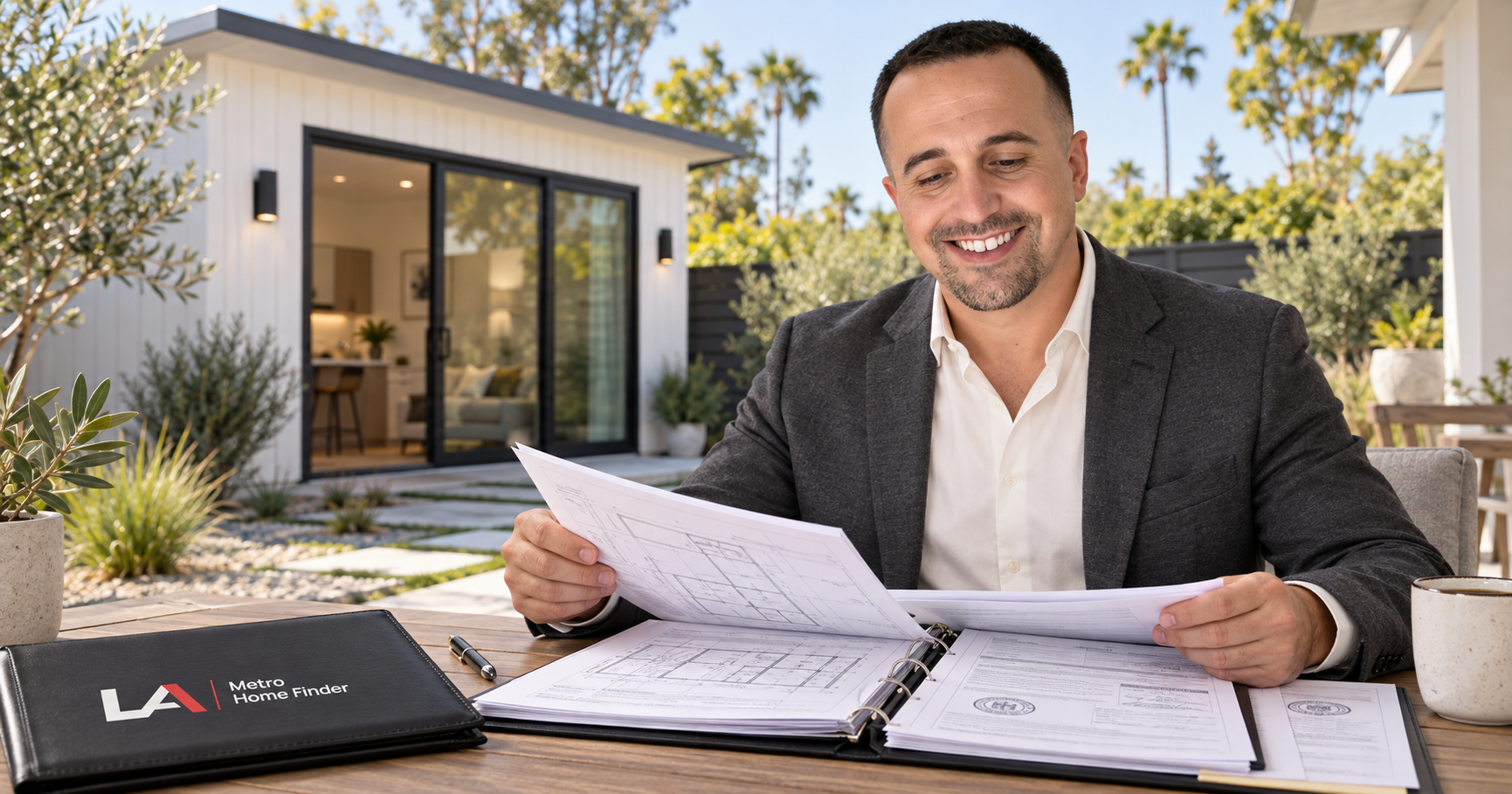
A Los Angeles buyer should not have to reverse-engineer your accessory dwelling unit from scattered screenshots, old contractor emails, and a listing remark that says “permitted.” Build one indexed record packet that shows what was approved, what was inspected, what was finalized, and what still needs an answer.
Want a clean ADU document request list before your Los Angeles sale goes live?
What Belongs in a Buyer-Ready ADU Record Packet?
Start with an index, not a document dump. The first page should identify the property address, assessor parcel number, permitting jurisdiction, ADU type, permit number, approved use, approved bedroom and bathroom count, approved floor area, and the status shown by the building department. If the ADU has its own address, list both the main-house and ADU addresses.
Behind that index, organize the records in the order a buyer, inspector, appraiser, lender, insurer, or real-estate professional is likely to review them:
- Issued building permit: Include the complete permit record, scope description, issuance date, and status page.
- Final inspection evidence: Include the finaled permit page and the inspection sequence, not only the first permit receipt.
- Certificate of Occupancy: Add it when the jurisdiction issued one for the ADU or change of occupancy. Do not manufacture an expectation that every project has the same closeout document.
- Building Card or inspection history: In the City of Los Angeles this may be called the Building Card, or B8. It helps show inspection milestones and whether a final approval appears.
- Approved plans: Provide the final stamped site plan and floor plan, plus approved structural sheets when available. These let a buyer compare the approved layout with the structure standing today.
- Trade permits: Include electrical, plumbing, mechanical, sewer, and other permits tied to the ADU, together with their final status.
- Recorded documents: Include ADU or JADU covenants, affidavits, address assignments, easements, and deed restrictions found in the project or title file.
- Corrections and enforcement: Include known correction notices, orders to comply, code cases, and written proof of closure. An open issue belongs in the packet, not outside it.
- Supporting history: Contractor invoices, warranties, energy documents, utility correspondence, and photographs are useful support, but label them as support rather than approval.
LADBS specifically directs owners to retain the Certificate of Occupancy and Building Card among their project records (LADBS, accessed October 13, 2026).
Concrete anchor: your packet should begin with one index and separate the building permit, final inspection, occupancy record, approved plans, trade finals, recorded documents, and open issues.
If the records reveal an approval gap, understand the selling options before you describe the unit.
Read the ADU Legalization GuideWhat Does Each ADU Record Actually Prove?
A thick permit file can still leave the central question unanswered. The buyer needs to know whether the built ADU matches the approved work and whether the permitting authority closed the project. Read the records as a chain rather than treating any single page as conclusive. LADBS describes sequential inspections and a final inspection at completion (LADBS Inspection, accessed October 13, 2026).
| Record | What it supports | What it does not prove alone |
|---|---|---|
| Permit application | A project was submitted with a stated scope. | Approval, construction, inspection, or completion. |
| Issued permit | The agency authorized the described work to proceed. | That construction matches plans or passed final inspection. |
| Inspection history | Which inspections were requested and their recorded results. | That omitted trades or later alterations were approved. |
| Finaled permit | The permit record shows final approval or completion. | That the present layout remains identical to the approved plans. |
| Certificate of Occupancy | The approved occupancy described by the issuing authority. | That every later remodel, rental practice, or tax record is compliant. |
| Assessor record | How the assessor currently characterizes improvements for assessment purposes. | Building-department permit and inspection approval. |
For example, a detached unit can appear in an assessor portal while a trade permit remains open. The reverse can also happen: a completed permit may not yet be reflected in every secondary database. Treat the permitting authority's record as the starting point, then use assessor and title records to identify inconsistencies that need explanation.
Decision threshold: do not advertise the ADU as final based only on an issued permit, tax record, rental history, utility bill, or MLS remark.
Compare current Los Angeles homes with ADUs while you prepare your own disclosure packet.
Search Los Angeles HomesWhich Los Angeles Permitting Authority Has the Records?
“Los Angeles” is not one permit office. A City of Los Angeles address generally starts with the Los Angeles Department of Building and Safety. LADBS provides a Permit and Inspection Report, online building records, and a Records Research Request for documents that are not available as downloadable PDFs. Los Angeles City Planning's ZIMAS supplies zoning and parcel context, but zoning information is not a substitute for the LADBS inspection and completion record.
An unincorporated Los Angeles County property follows Los Angeles County Public Works Building and Safety processes. County Building and Safety also serves certain contract cities (County of Los Angeles, accessed October 13, 2026). Pasadena, Glendale, Long Beach, Santa Monica, Culver City, and many other incorporated cities maintain separate records. The municipal name in the mailing address does not always identify the agency with jurisdiction, so confirm it before ordering records.
For a City of Los Angeles property
- Pull the Permit and Inspection Report for the parcel and every known address.
- Search LADBS online building records for permits, plans, occupancy records, and related documents.
- Use the Records Research Request when a required document is not available online.
- Review ZIMAS for zoning, case numbers, overlays, and parcel context.
- Compare the approved plan and scope with the current physical layout.
Los Angeles neighborhoods also add practical context. A garage conversion in Highland Park may involve an older permit chain and historic-overlay questions. A detached ADU in Granada Hills may have separate grading or utility records. A duplex conversion in Mid City may require closer review of unit count and use. These examples are why a generic California checklist is not enough for an LA sale.
Named-agency anchor: City of Los Angeles sellers should reconcile LADBS permit and inspection records with ZIMAS parcel context; unincorporated County sellers should start with Los Angeles County Building and Safety.
See the current housing context in different LA-area jurisdictions while keeping each permit search local.
How Should I Reconcile Conflicting ADU Records?
After collecting documents, create a reconciliation sheet. Put the official record fields in one column and the observed property in another. Compare address, parcel number, ADU type, floor area, bedroom count, bathroom count, kitchen, entrances, parking notes, utility configuration, and permit status.
Common conflicts include a permit for a recreation room while the current space contains a kitchen; an approved studio that now has a separate bedroom; an ADU address used in leases but missing from the permit file; a final building permit with an open electrical permit; or an assessor entry that uses a different floor area. None of these automatically produces the same answer. Each tells you what to ask the proper agency or licensed professional.
If a wall, bedroom, bath, deck, laundry connection, panel, water heater, or doorway was changed after final approval, identify it. Do not quietly give the buyer the old approved plan and assume the plan proves the current configuration. A plan-to-condition comparison is more credible than a folder of unexplained documents.
California's Transfer Disclosure Statement asks about additions, structural changes, alterations, or repairs made without necessary permits or not in compliance with building codes (California DRE, RE 6, accessed October 13, 2026). It is a disclosure, not a warranty and not a replacement for inspections. A seller should answer based on actual knowledge and obtain legal advice for transaction-specific disclosure questions.
Decision threshold: if the approved plan and current layout disagree on use, square footage, bedrooms, bathrooms, or trade work, resolve or clearly disclose the discrepancy before marketing the ADU as approved.
Need help organizing the real-estate side of one LA ADU record conflict?
Call (213) 262-5092What to Do When ADU Records Are Missing or Open
Missing paperwork is not permission to guess. First, search all known addresses, the assessor parcel number, previous permit numbers, and the owner's name where the agency permits that search. An ADU may be indexed under the main residence, a new unit address, or a project description that does not use the modern term “ADU.”
Second, request archived records. In the City of Los Angeles, LADBS directs requesters to its Records Research Request process for documents not available as PDFs through online records. Ask for the permit history, inspection record, approved plans, Certificate of Occupancy data, and related code-enforcement material that can be released.
Third, separate a missing copy from a missing approval. If the agency shows a finaled permit but your paper copy is gone, replacement research may solve the file problem. If the permit is expired, open, withdrawn, or missing a final, that is a project-status issue. If no permit can be located, do not describe the unit as permitted simply because a contractor, previous owner, or old listing said it was.
Fourth, get the right professional involved. A qualified architect, engineer, contractor, permit consultant, attorney, tax adviser, or insurance professional may be needed depending on the discrepancy. A real-estate agent can coordinate the transaction and help frame buyer questions, but should not issue a legal conclusion or building-code certification.
Agency anchor: use the LADBS Records Research Request for unavailable City of Los Angeles documents, and treat an open or expired permit as a status problem rather than a missing-paper problem.
If the unit may predate the current permit history, review the evidence path before making a representation.
Read the Pre-2020 ADU Evidence GuideHow Should I Deliver ADU Records to a Buyer?
Create a locked PDF packet or organized read-only folder. Name each file with the permit number and record type. Put the index first, then the authoritative agency documents, approved plans, recorded instruments, supporting documents, and your written gap list. Preserve the original agency downloads as well as the assembled packet.
- Collect: Gather every known agency, title, contractor, utility, warranty, and lease record tied to the ADU.
- Verify: Confirm the parcel, jurisdiction, permit numbers, and current online status.
- Compare: Walk the ADU with the approved floor plan and note visible differences for professional review.
- Reconcile: Write a short, neutral explanation for missing or inconsistent records. Do not speculate.
- Deliver: Provide the packet through the transaction's document process early enough for buyer investigation.
- Update: If a permit status, correction, or material fact changes before closing, update the packet and disclosures promptly.
Do not redact a permit number or address merely to make the packet look cleaner. Do protect account numbers and unrelated sensitive personal information. Keep a delivery record showing what was provided and when. Your agent and attorney can advise on the transaction's document-delivery procedure.
A special rule deserves attention for recent resellers. California Civil Code section 1102.6h applies to certain single-family sales when the seller accepts an offer within 18 months after taking title. It requires specified contractor work since acquisition to be disclosed, and when the seller obtained permits for that disclosed work, copies must be provided. The provision applies to qualifying offers accepted on or after July 1, 2024 (CA Civil Code § 1102.6h, effective July 1, 2024). It is not the only disclosure duty, so sellers should not treat the 18-month rule as a safe harbor.
Timeline anchor: for a qualifying recent-reseller transaction, review Civil Code section 1102.6h when the offer is accepted within 18 months after the seller took title.
Organize the packet before photography, pricing, and buyer questions compress your timeline.
Text About Your ADU SaleOfficial Sources to Recheck for Your Property
Permit status can change, and local practices differ. Recheck the live agency record for the exact parcel before relying on a status description. California's current statewide framework appears in the March 2026 ADU Handbook (California HCD, March 2026). County assessor guidance separately directs owners to confirm requirements with the local permitting agency (LA County Assessor, accessed October 13, 2026).
- LADBS Search Online Building Records for City of Los Angeles record retrieval and research requests.
- LADBS Plan Check and Permit for permit tools, property records, and completion-document guidance.
- LADBS Inspection for inspection sequence and final-approval context.
- Los Angeles City Planning ZIMAS for City zoning and parcel context.
- California HCD Accessory Dwelling Unit Handbook, March 2026 for current State ADU Law context.
- California DRE, Disclosures in Real Property Transactions for the statutory Transfer Disclosure Statement and disclosure framework.
- California DRE 2026 Real Estate Law Excerpts for Civil Code section 1102.6h and related provisions.
- Los Angeles County Building and Safety for unincorporated County and contract-city jurisdiction information.
- Los Angeles County Assessor ADU guidance for assessor context and the direction to confirm requirements with the local permitting agency.
Sources accessed October 13, 2026. This guide is general real-estate information, not legal, tax, appraisal, insurance, engineering, or building-code advice.
Current-source anchor: the governing state reference is California HCD's March 2026 ADU Handbook; the completion evidence comes from the agency with jurisdiction over the parcel.
See how buyers evaluate ADU value after you have organized the permit record.
Read the LA ADU Value GuideFrequently Asked Questions About ADU Permit Records
Is an issued ADU permit enough to give a buyer?
No. An issued permit shows authorization for the described work to proceed. It does not, by itself, show that required inspections were passed or that the permit received final approval. Give the buyer the issued permit together with the inspection history, final status, approved plans, trade permits, and Certificate of Occupancy when one was issued.
Do I need a Certificate of Occupancy for my ADU sale?
Provide the Certificate of Occupancy if the permitting authority issued one for the ADU or applicable occupancy change. Do not assume every jurisdiction and project type uses the same closeout document. Confirm the exact completion evidence with the building department that has jurisdiction over your parcel.
Can an assessor record prove my Los Angeles ADU is permitted?
No. An assessor record can support the property's improvement and assessment history, but it does not replace the building department's permit, inspection, and final-approval records. Compare the assessor entry with LADBS, County Building and Safety, or the correct incorporated-city record.
What if the approved ADU plan does not match the current layout?
Document the difference and obtain project-specific guidance before marketing the current configuration as approved. Changes to walls, bedrooms, bathrooms, kitchens, utilities, entrances, or floor area may require agency or licensed-professional review. Give the buyer both the approved plan and an accurate disclosure of known differences.
Should I give buyers open correction notices or code cases?
Yes. Known open corrections, orders to comply, and code-enforcement matters are material to the buyer's investigation. Include the notice, current status, related correspondence, and closure evidence if the matter was resolved. Do not omit an open record because it complicates the sale.
When should I collect the ADU records before listing?
Start before the property is marketed. Archived plans and occupancy records can require a separate agency request, and a record conflict may need professional review. Early collection gives you time to reconcile the packet before a buyer, appraiser, lender, or insurer raises the issue during escrow.
Does giving buyers permit records replace California seller disclosures?
No. The permit packet supports the buyer's investigation, but it does not replace the Transfer Disclosure Statement or other transaction-specific duties. California Civil Code section 1102.6h also imposes added contractor-work and permit-copy requirements for certain recent resellers. Ask qualified counsel about your facts.
Practical anchor: collect records before marketing and give buyers both the official approvals and a neutral list of unresolved gaps.
About the Author

Justin Borges
Justin helps Los Angeles sellers organize the real-estate questions around ADU permit records, buyer investigation, and disclosure timing. He has held an active California DRE salesperson license since October 2013, CA DRE #01940318. Review Justin's verified author profile.
Ready to build the ADU record packet for your Los Angeles sale?