



Los Angeles ADU Records Guide
How Do I Prove My Unpermitted ADU Was Built Before 2020?
The short answer
Prove the date with a layered evidence packet, not one document. Start with government records tied to the parcel, then add contemporaneous leases, appraisals, insurance files, contractor invoices, utility history, dated listing photos, original photographs with preserved metadata, and declarations from people with first-hand knowledge. Your packet should show that the space functioned as a dwelling before January 1, 2020, not merely that a garage or detached shell existed.
California Government Code section 66311.7 gives qualifying pre-2020 unpermitted ADUs and JADUs an important path to permitting. It does not declare the unit legal, guarantee that your evidence will be accepted, or erase health-and-safety corrections. Ask the permitting agency for your exact address what it will accept before filing.
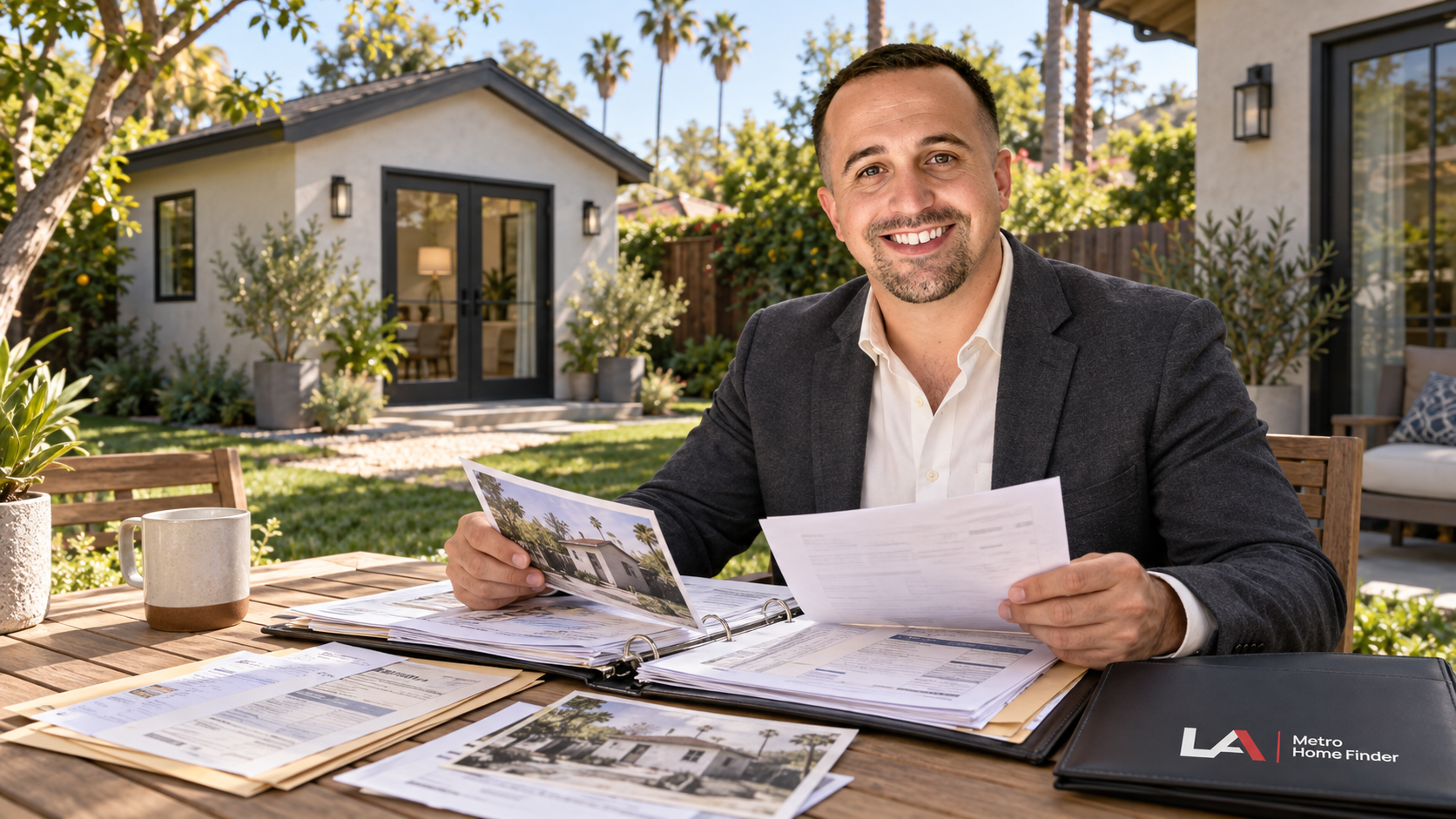
Organize the evidence before you market the property
A local real estate adviser can help you separate the property-record questions, disclosure issues, and sale strategy for a Los Angeles home with an unpermitted ADU.
What does the pre-2020 ADU rule actually do?
Government Code section 66311.7 says a local agency generally may not deny a permit for an unpermitted ADU or JADU constructed before January 1, 2020 merely because it violates building standards, State ADU Law, or a local ADU ordinance (California Legislature, accessed 2026). AB 2533, Chapter 834 of the Statutes of 2024, expanded the former pre-2018 rule and took effect on January 1, 2025 (California Legislature, 2024). The California Department of Housing and Community Development explains the same rule in its March 2026 ADU Handbook (California HCD, March 2026).
That protection is meaningful, but it is not automatic amnesty. The local agency may make health-and-safety findings, may inspect the unit, and may require work needed to correct qualifying conditions (California HCD, March 2026). HCD also says owners may obtain a confidential third-party code inspection from a licensed contractor before applying (California HCD, March 2026). A final permit or certificate of occupancy still comes from the local authority, not from an old photograph, assessor entry, or real estate listing.
For Los Angeles owners, the concrete threshold is January 1, 2020, and the controlling agencies are HCD at the state level and the permitting authority for the parcel at the local level.
Before assuming a City of Los Angeles process applies, confirm the parcel jurisdiction and compare current homes with documented second-unit histories.
What do you need to prove for a California pre-2020 ADU?
For a California filing, your file should answer two separate questions: what physical space existed before the cutoff, and when that space became a dwelling. That distinction matters when a detached garage appeared on an old assessor sketch but the kitchen, bathroom, sleeping area, utilities, and separate occupancy came later.
Show the structure and the residential use
A dated aerial image may establish that a backyard building existed. A 2019 lease describing a rear unit, an appraisal identifying a second living area, dated interior photos showing a kitchen and bath, or invoices for residential fixtures can help address when the building functioned as housing. No single item must do every job. Consistency across independent records is more persuasive than a stack of documents that all trace back to one unsupported statement.
Keep “constructed” tied to your local agency’s review
The statute uses “constructed before January 1, 2020,” but it does not provide homeowners with one universal evidence checklist. Do not assume your preferred document controls. Ask the agency to identify its intake requirements, whether it wants a declaration, and how it treats a preexisting accessory structure that was converted in stages.
| Evidence | What it can help show | Main limitation |
|---|---|---|
| Permit, inspection, or code file | Official dated activity tied to the parcel or structure | May describe only the garage, addition, violation, or main house |
| Lease, appraisal, insurance, or escrow file | Third-party recognition of a separate living space at a specific time | Does not prove permits or code compliance |
| Original dated photographs | Exterior existence and visible residential features | Metadata can be missing; a photo may not identify the parcel clearly |
| Utility or contractor records | Service, fixtures, or work associated with habitation | A meter or invoice may serve another building or project |
| First-hand declaration | Personal observations about use and timing | Usually stronger when corroborated independently |
The decision threshold is not “Do I have one old photo?” It is “Can my evidence identify this parcel, this unit, residential use, and a date before January 1, 2020?”
Where should you search for Los Angeles ADU records?
First confirm jurisdiction. “Los Angeles” can mean the City of Los Angeles, another incorporated city in Los Angeles County, or an unincorporated County area. A Pasadena address goes to Pasadena’s building authority. Glendale has its own process. A City of Los Angeles parcel generally begins with LADBS.
For a City of Los Angeles address
Search LADBS PRISM by address and by Assessor Parcel Number. LADBS says PRISM can retrieve permits, plans, certificates of occupancy, inspection and code-enforcement materials, and related documents. Its Property Records page lists building permits from 1905 forward, certificates of occupancy from 1940 forward, range files, plot plans, affidavits, approved plans, and certain electrical, plumbing, and mechanical records. Search address variations and the APN because a rear structure may be indexed differently from the mailing address.
If the relevant document is not online, send a records request to the LADBS Records Section. Blueprint access has additional ownership and authorization rules, so do not make the entire strategy depend on receiving another owner’s plans.
Use County assessor data carefully
The Los Angeles County Assessor portal can help identify the parcel and building data. The Assessor explains that “Year Built” is when at least 50 percent of the original construction was complete, while “Effective Year Built” accounts for later new construction or major rehabilitation. Those fields may generate leads, but they are not an automatic date for the ADU conversion and are not proof that the unit is legal.
For a City of Los Angeles parcel, the named starting system is LADBS PRISM. For Pasadena or Glendale, use that city’s permitting authority rather than treating County data as a substitute.
Comparing a Pasadena property while you sort out a rear-unit timeline?
How do you build a credible California pre-2020 ADU evidence packet?
For a California property, use this eight-step sequence.
- Write the question narrowly. Identify the address, APN, unit location, unit type, and the proposition you need to establish: the ADU or JADU was constructed before January 1, 2020.
- Preserve originals. Keep original electronic files, envelopes, complete reports, and unedited photos. Export working copies, but do not overwrite metadata or crop away identifying context.
- Collect government records first. Save the full permit, inspection, code, certificate, plot-plan, and assessor records, including pages that appear inconsistent with your preferred timeline.
- Add independent third-party records. Look for leases, rental applications, appraisals, insurance inspections, escrow packages, contractor invoices, utility correspondence, prior MLS materials, and dated professional photographs.
- Map each item to a fact. Label whether it shows parcel identity, the physical structure, residential features, occupancy, or date. Do not ask one document to prove something it does not say.
- Use declarations as corroboration. A prior owner, neighbor, tenant, or contractor should state only what that person directly observed, when, and how they know the location. Avoid rehearsed legal conclusions.
- Create an exhibit index. Put the records in chronological order with source, date, description, and relevance. Flag conflicts for the designer, contractor, attorney, or agency instead of hiding them.
- Ask for agency-specific instructions. Before filing, confirm whether the local agency wants a particular declaration, plan set, inspection, or date evidence format.
A useful packet is transparent. If a 2018 aerial shows the shell but a 2020 invoice shows the kitchen installation, include both and obtain professional advice about what the record establishes. Concealing the later invoice can undermine credibility and create separate disclosure problems during a sale.
The concrete deliverable is a chronological exhibit index that addresses four points: parcel, structure, dwelling use, and a date before January 1, 2020.
Request the ADU evidence checklist
Use a property-specific checklist to organize public records, private records, disclosure questions, and the sale calendar.
What if your documents show conflicting dates?
Conflicts are common because different records measure different events. An assessor’s original year built may refer to the main house. A permit may cover a garage, not a dwelling. A lease may prove occupancy but not the construction date. An MLS description may repeat a seller’s statement without verification.
Build a timeline that separates at least four milestones: accessory structure existed, conversion work occurred, residential use began, and permits or enforcement activity occurred. Then identify the earliest independently supported date for each milestone. This makes it easier for a design professional or local agency to see exactly where the uncertainty sits.
Do not “clean up” the evidence
Never alter photo metadata, recreate an invoice, backdate a lease, or pressure a witness to adopt a date. Preserve contradictory records and explain them. If a prior listing called the space a “studio” in 2019 but the only documented plumbing work is from 2021, that is a professional-review issue, not a wording problem.
If the evidence does not reliably establish pre-2020 dwelling construction, do not force the AB 2533 theory. Ask the local agency and qualified professionals about the ordinary current-code pathway, correction work, removal, or other lawful options. The decision threshold remains credible evidence of construction before January 1, 2020.
Glendale records and City of Los Angeles records are not interchangeable. Compare current Glendale homes while confirming the correct local file.
What happens after you document that the ADU predates 2020?
A date packet is an input to the permitting process, not the finish line. The next step is usually to confirm the agency pathway, retain the appropriate design and construction professionals, document existing conditions, and prepare the permit application. HCD states that a homeowner may obtain a confidential third-party code inspection from a licensed contractor before applying. That can help scope likely health-and-safety work without pretending to be an agency approval.
The local inspector may inspect a previously unpermitted unit for compliance with health-and-safety standards. Corrections can still matter for issues such as unsafe wiring, inadequate sanitation, dangerous exits, structural hazards, or other substandard conditions under Health and Safety Code section 17920.3. A protected path is not a promise that the unit can remain unchanged.
If you may sell before legalization is complete
Coordinate the permit strategy with real estate disclosure and marketing. Do not advertise the space as a legal ADU merely because you assembled evidence that it existed before 2020. Buyers, lenders, appraisers, insurers, and escrow professionals may treat unpermitted living area differently. The listing should distinguish verified facts from plans, applications, estimates, and unresolved agency determinations.
In Los Angeles, a sensible handoff involves the local permitting agency, a qualified designer or architect when needed, a licensed contractor for condition and correction questions, and a California real estate or legal professional for sale and disclosure issues. The named statutory pathway is Government Code section 66311.7, but the property-specific result belongs to the local agency.
Coordinate the ADU file with your sale plan
If you are deciding whether to permit first or sell with the issue disclosed, organize the timeline before photos, pricing, and marketing language are finalized.
Frequently asked questions
Is a dated photo enough to prove my ADU was built before 2020?
Usually, a photo is better treated as one exhibit in a larger packet. An exterior photo may prove that a structure existed, but not that it functioned as a dwelling. Preserve the original file and metadata, identify the parcel, and corroborate it with government, third-party, interior, occupancy, or construction records. The local permitting agency decides what evidence it will accept.
Does the County Assessor’s year built prove the ADU conversion date?
No. The Los Angeles County Assessor says “Year Built” concerns completion of the original construction, while “Effective Year Built” reflects later new construction or major rehabilitation. Either field may help identify a lead, but it may describe the main house or another improvement. It does not by itself prove when an accessory structure became an ADU or that the conversion was legal.
Can old utility bills prove the unit existed before 2020?
They can corroborate a timeline if the records clearly connect service or usage to the accessory unit. A bill for the parcel alone may not show which structure used the service, and a separate meter does not prove residential approval. Pair utility records with plans, photos, leases, inspections, invoices, or other evidence that identifies the unit and its dwelling features.
What if the garage existed before 2020 but the conversion happened later?
Evidence of the garage footprint may not establish that the ADU was constructed before the statutory cutoff. Create a timeline for the shell, kitchen, bathroom, sleeping area, utilities, and occupancy. Present the complete record to the local agency and qualified professionals. If the dwelling conversion cannot be placed before January 1, 2020, ask about the ordinary permitting pathway rather than overstating the evidence.
Will AB 2533 legalize my unpermitted ADU automatically?
No. AB 2533 expanded protections for qualifying unpermitted ADUs and JADUs constructed before January 1, 2020, but it did not convert them into automatically legal units. You still need the local permitting process, and health-and-safety findings or correction work may apply. A permit or certificate of occupancy comes from the responsible local agency.
Should I get an inspection before applying?
Government Code section 66311.7 requires public information to tell homeowners they may obtain a confidential third-party code inspection from a licensed contractor before applying. That review can help identify existing conditions and a potential correction scope. It is not a substitute for the local agency’s inspection, plan check, permits, or final approval.
Primary sources and Los Angeles records
- California HCD, Accessory Dwelling Unit Handbook, updated March 2026
- California Government Code section 66311.7
- AB 2533, Chapter 834, Statutes of 2024
- California Health and Safety Code section 17920.3
- HCD technical assistance to the City of Los Angeles, August 14, 2025
- LADBS Property Records and LADBS PRISM
- Los Angeles City Planning ZIMAS guidance
- Los Angeles County Assessor mapping help and Assessor Portal
This article provides general educational information, not legal, architectural, engineering, tax, or permitting advice. Requirements and evidence decisions are property-specific. Confirm current rules with the agency responsible for your parcel and consult qualified professionals before acting.

About Justin Borges
Justin Borges helps Los Angeles owners organize property records, ADU questions, disclosure files, and listing strategy. He has held an active California DRE salesperson license since October 2013, CA DRE #01940318.