



Los Angeles ADU legalization
Should I Get a Third-Party Inspection Before Applying to Legalize My ADU?
Yes, in many Los Angeles cases, a focused third-party inspection is a sensible first move before you submit plans to legalize an unpermitted ADU. It can identify health and safety problems while you still have time to scope repairs, compare professionals, and make the drawings accurate. It is especially useful if the unit was created before January 1, 2020 and may qualify for the protections added by California Assembly Bill 2533 (California HCD, March 2026).
Short answer: get the inspection when you do not know how the unit was built, when electrical, plumbing, structural, fire-safety, sanitation, or egress conditions are uncertain, or when a notice or transaction creates a deadline. In the City of Los Angeles, LADBS says the pre-application inspection is optional, for the homeowner's information, and does not replace permits or official LADBS inspections. The private report also is not required to be submitted or disclosed to LADBS. Use the current City checklist and hire a professional whose license fits the work.
Sources: California Government Code §§ 66311.7 and 66317; Health and Safety Code § 17920.3; LADBS P/BC 2026-150.
Check the current Los Angeles ADU guidance before you scope a private inspection.
Review the LADBS ADU GuideA risk decision, not a ritual
When Is a Third-Party ADU Inspection Worth Doing?
The inspection is most valuable when it resolves uncertainty that would otherwise reach plan check. Many unpermitted Los Angeles units began as garage conversions, additions, recreation rooms, workshops, or detached structures. The visible finishes may look acceptable while the permit record says something different. A private inspection gives you and your designer a factual starting point before existing conditions are represented on the plans.
Consider an inspection a strong recommendation when you inherited the property, bought it with limited records, cannot identify the person who performed the conversion, or see signs of improvised work. Warning signs include an undersized electrical panel, extension-cord wiring, missing GFCI protection, a water heater in a sleeping area, no obvious heating source, low ceiling clearances, bedroom windows that may not provide emergency escape, moisture staining, a sloped floor, patched framing, or plumbing that was added without a clear venting path.
A pre-application review also helps when the property is being sold or refinanced. A buyer, lender, insurer, appraiser, or escrow officer may ask whether the unit is legally recognized. The inspection does not answer that legal-status question, but it can separate a correctable physical problem from a records or zoning problem. That distinction makes cost estimates and negotiations more honest.
The practical threshold is simple: if one undiscovered condition could materially change the plans, repair scope, occupancy, or transaction decision, inspect before applying. For a City of Los Angeles pre-2020 unit, anchor the scope to the LADBS City of Los Angeles Substandard Checklist and the statewide substandard-building framework (Health & Safety Code § 17920.3).
Trying to decide whether an unpermitted ADU changes a Los Angeles purchase or sale strategy? Text your property question to (213) 262-5092.
Text Your ADU QuestionDefine the scope in writing
What Should the Third-Party Inspector Examine?
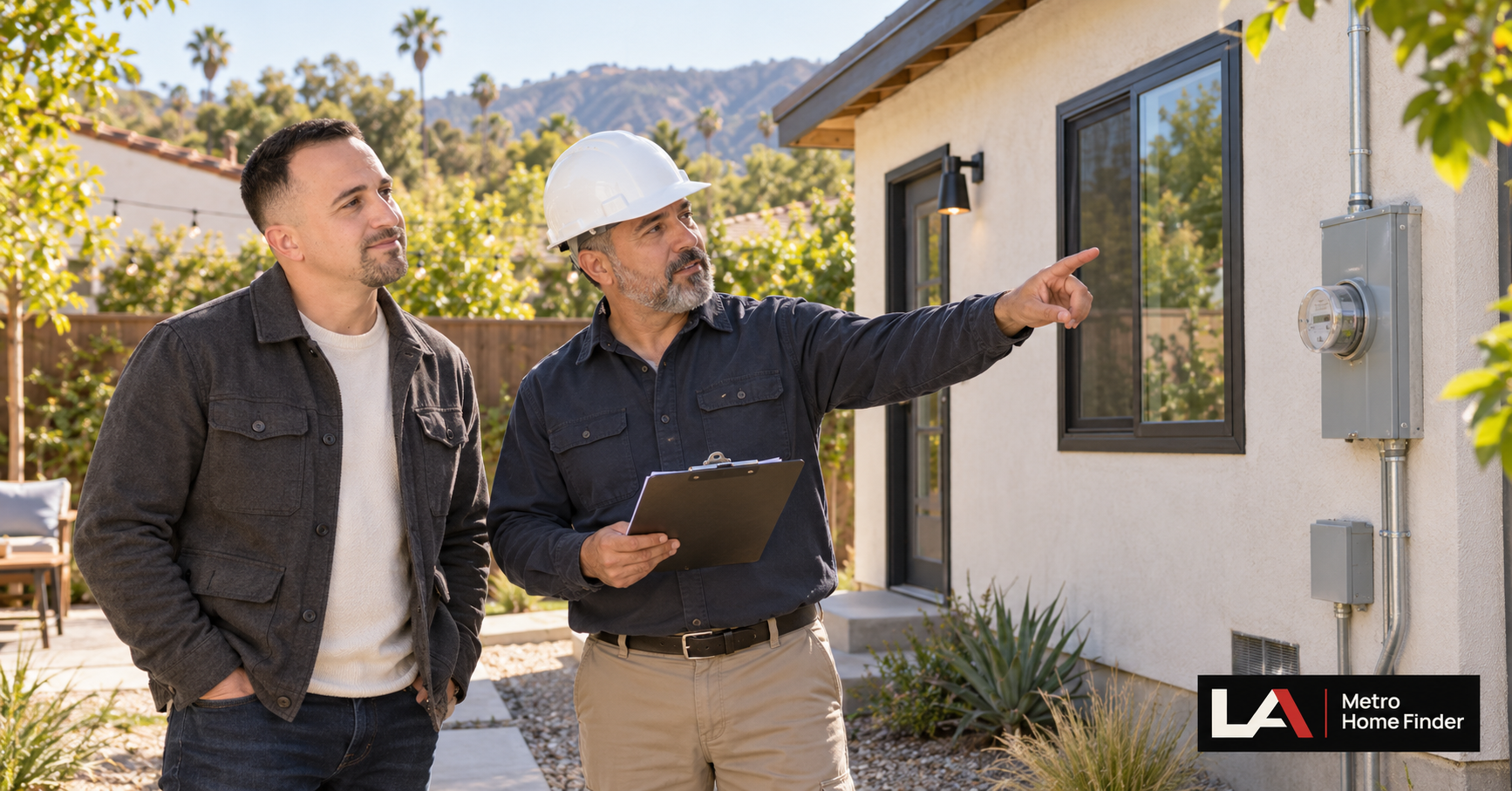
Ask for a written, code-focused condition assessment of the actual ADU, not a quick verbal walk-through. The professional should document observations, inaccessible areas, assumptions, photographs, likely corrective work, and which questions require destructive investigation, engineering, specialty trades, or the building department. Your goal is a usable input for plans and budgeting.
| Area | Questions to document | Possible next specialist |
|---|---|---|
| Structure and foundation | Is there visible distress, altered framing, inadequate support, settlement, or an unverified addition? | Licensed civil or structural engineer |
| Fire and life safety | Are sleeping-room escape, smoke and carbon-monoxide alarms, fire separation, exits, and address visibility adequate? | Architect, engineer, or licensed contractor |
| Electrical | Is service capacity known, wiring protected, panels accessible, circuits identified, and required protection present? | Licensed electrical contractor |
| Plumbing and sanitation | Do fixtures drain, vent, and receive hot and cold water without visible leaks or unsafe connections? | Licensed plumbing contractor |
| Mechanical and ventilation | Is permanent heating provided, combustion equipment safely located, and ventilation reasonably documented? | Licensed HVAC contractor |
| Weather and habitability | Are roof, walls, windows, moisture control, room dimensions, light, ventilation, and sanitation conditions serviceable? | Architect or qualified licensed contractor |
| Site conditions | Are access, setbacks, utilities, drainage, slope, fire access, and other site constraints likely to affect plans? | Designer, surveyor, geotechnical or civil professional |
A visual inspection cannot verify concealed footing dimensions, hidden reinforcement, buried sewer work, or wiring behind finished walls. If the professional cannot support a conclusion without opening a wall or testing a system, the report should say so. Do not let a clean-looking interior become proof of unseen construction.
Ask the inspector to classify findings into three groups: apparent safety corrections, items that must be shown or resolved in the plans, and items that require further investigation. That is more useful than a long defect list with no connection to legalization. In Los Angeles, the controlling safety anchor for a qualifying pre-2020 unit is the substandard-building framework in Health and Safety Code § 17920.3, as implemented through the current LADBS checklist.
Start with the current City bulletin before you define the private inspection scope.
Open the LADBS BulletinMatch the license to the question
Who Should Perform a Pre-Application ADU Inspection?
California's current AB 2533 framework describes a confidential third-party code inspection by a licensed contractor (California HCD, March 2026). The LADBS bulletin for certain pre-2020 unpermitted ADUs likewise says the owner may arrange an inspection by a licensed contractor. Hire someone with relevant residential alteration and legalization experience, not merely a person who offers a general home inspection.
An architect or engineer may be appropriate when the unit has structural changes, hillside conditions, additions, uncertain load paths, nonstandard framing, or plan work that will require professional judgment. Specialty contractors can evaluate electrical, plumbing, HVAC, roofing, or foundation concerns. The person who performs one walk-through does not need to be the only professional involved.
Questions to ask before the site visit
- What California license applies to this inspection, and is it active?
- Have you evaluated existing unpermitted ADUs for legalization in the same jurisdiction?
- Will you use the current LADBS or local agency substandard-condition checklist?
- Will the deliverable include photographs, inaccessible conditions, recommended follow-up, and a repair-priority list?
- Are you also bidding the repair work, and how will you separate inspection findings from sales recommendations?
- Which parts of the assessment are outside your license or competence?
Verify a contractor through the Contractors State License Board before signing an agreement. CSLB advises consumers to check current status and complaint disclosures, review insurance information, and compare written bids. If corrective construction will total $1,000 or more in labor and materials, California generally requires an appropriately licensed contractor (CSLB, 2026).
Do not select solely on the lowest fee. Select for a documented scope, a suitable active license, relevant Los Angeles legalization experience, and independence of judgment. Verify the license through the California Contractors State License Board.
Verify the professional before relying on the report or authorizing repair work.
Check a CSLB LicenseCity and county are not interchangeable
How Does Los Angeles Apply the Pre-2020 ADU Rule?
Start by identifying the permitting authority. A Los Angeles mailing address does not prove the property is inside the City of Los Angeles. City properties use LADBS and Los Angeles City Planning. Unincorporated Los Angeles County properties use County departments, and incorporated cities such as Pasadena, Glendale, Burbank, Culver City, Long Beach, or West Hollywood have their own building agencies and procedures.
For a qualifying unpermitted ADU or JADU constructed before January 1, 2020, Government Code § 66311.7 limits a local agency's ability to deny the permit merely because the unit violates building standards, State ADU Law, or a local ADU ordinance (California HCD, March 2026). The local agency may still require correction when necessary to protect occupants or the public from substandard conditions under Health and Safety Code § 17920.3. This is a legalization pathway, not blanket forgiveness of unsafe construction.
The current LADBS bulletin says the private inspection is for the homeowner's information only. It does not resolve the permit, exempt the owner from required permits or official inspections, or bind LADBS. The results are not required to be submitted or disclosed to LADBS. Plans still must identify noncompliant items and proposed corrections, and the permit application must identify the AB 2533 basis when applicable.
LADBS also identifies examples of evidence that can establish a pre-2020 construction date: rent registration records, contractor bills or building-material receipts, utility bills, insurance documents, code-enforcement records, signed and dated leases, loan or appraisal records, and MLS material. Collect this evidence before making the eligibility assumption. A fresh inspection can document current condition, but it cannot prove when the unit was built.
AB 2533 also restricts impact fees and connection or capacity charges for qualifying pre-2020 legalization, except in specified circumstances such as utility improvements needed for health and safety (California HCD, March 2026). A complete ADU permit application is generally subject to the 60-day state review period in Government Code § 66317 (HCD, March 2026), but incomplete applications, required corrections, other agency issues, and owner-requested changes can affect the real calendar.
For a City of Los Angeles parcel, the named starting points are LADBS PRISM for records and the current LADBS ADU bulletins. If the property is outside city limits, stop using the City checklist as if it were the approval authority and contact the actual city or LA County agency.
Confirm City of Los Angeles permit history before designing the legalization scope.
Search LADBS Property RecordsTurn findings into an application plan
What Should You Do After the Inspection?
Do not begin opening walls or replacing systems simply because a private report lists a concern. First, give the report, permit history, date evidence, measurements, photographs, and intended use to the professional preparing the plans. That person can determine which corrections belong on the application and which additional investigations are justified.
Build a decision file with five columns: observed condition, source, needed answer, responsible professional, and deadline. This prevents an electrician's observation from becoming an unsupported structural conclusion or a designer's zoning assumption from becoming a permit fact.
| Step | Deliverable | Decision gate |
|---|---|---|
| 1. Confirm jurisdiction | Parcel and agency record | City of LA, unincorporated county, or another city |
| 2. Pull history | Permits, certificates, plans, enforcement records | What use and structure are already recognized? |
| 3. Establish age | At least one credible pre-2020 record when claiming AB 2533 treatment | Does Government Code § 66311.7 apply? |
| 4. Inspect condition | Written code-focused report and photos | What threatens safety, feasibility, or budget? |
| 5. Prepare plans | Accurate existing and proposed drawings | Are all known corrections represented? |
| 6. Submit and respond | Complete application and correction log | What does the actual agency require? |
| 7. Build and inspect | Approved work and official signoffs | Has the agency granted final approval? |
Get repair pricing from the plan scope rather than from a loose list of symptoms. The final cost can change after plan check or official inspection reveals concealed conditions. Keep a contingency and require written change orders. If the ADU is occupied, coordinate access and habitability issues carefully and obtain legal advice for tenant questions.
The private inspection has done its job when it makes the plans, budget, and owner decision more accurate. The official finish line remains permit issuance, completed corrective work, required agency inspections, and final approval by the authority having jurisdiction.
Need to evaluate how ADU status could affect a Los Angeles real estate decision? Call Justin at (213) 262-5092.
Call (213) 262-5092Spend diligence where it changes the result
When Might You Limit or Skip the Private Inspection?
You might limit a separate inspection when a qualified architect, engineer, or licensed contractor is already performing a documented code assessment as part of the legalization design, and the scope covers the same safety questions. Paying twice for an identical visual review may add little value. Confirm that the existing engagement actually includes the assessment and a written deliverable.
You also may move directly into agency consultation when the first issue is not building condition. For example, the structure may be outside the property line, located in a recorded easement, affected by a hillside or fire-zone constraint, or not eligible for the route you expected. A building-condition report cannot solve a threshold land-use or title issue.
Do not skip professional evaluation merely because the unit has been occupied for years, utilities work, taxes were assessed, an appraiser counted the space, or a prior owner called it an ADU. None of those facts alone proves lawful construction or safe condition. Likewise, do not assume AB 2533 requires the agency to approve every pre-2020 unit without correction.
If there is an immediate hazard such as exposed energized wiring, active gas leakage, sewage discharge, significant structural movement, blocked exits, or dangerous combustion conditions, do not wait for a routine legalization sequence. Keep people away from the hazard and contact the appropriate emergency service or qualified licensed professional.
The decision threshold is whether a separate report adds new, actionable information before plans are committed. If your retained design professional already supplies that information in writing, combine the scopes. If no one has accepted responsibility for the code-focused condition assessment, do not assume it will happen later.
Review California's current statewide ADU guidance before relying on an older legalization checklist.
Read the California ADU HandbookRelated Los Angeles resources
Research the Property Before You Price the ADU
Property records and agency rules determine legalization status. Current listings can help you compare how permitted ADUs are marketed, but a listing description is never a substitute for permit verification.
Common homeowner questions
Frequently Asked Questions
Is a third-party inspection required before I apply to legalize an ADU?
No. For a qualifying unpermitted ADU or JADU built before January 1, 2020, California and LADBS guidance describe the pre-application third-party inspection as optional. It can help you identify safety corrections and prepare accurate plans, but it does not replace the permit application or official agency inspections.
Will LADBS accept the private inspection instead of inspecting the ADU?
No. LADBS says the private inspection is for the homeowner's information only. It does not resolve or exempt the owner from required permits and LADBS inspections. The private findings are not required to be submitted or disclosed to LADBS.
Who can perform the confidential pre-application inspection?
California's AB 2533 framework and current LADBS guidance identify a licensed contractor for the optional inspection. An architect, engineer, or specialty contractor may also be needed when the unit presents structural, design, electrical, plumbing, mechanical, hillside, or other discipline-specific questions. Verify every applicable license before hiring.
Does AB 2533 guarantee approval of my unpermitted ADU?
No. Government Code § 66311.7 limits denial of certain pre-2020 ADUs for building-code, State ADU Law, or local ADU ordinance violations, but a local agency can require corrections needed to address substandard health and safety conditions. You still need the correct application, plans, corrective work, agency inspections, and final approval.
How do I prove my ADU was built before January 1, 2020?
LADBS identifies examples such as rent registration records, contractor bills, material receipts, utility or insurance documents, code-enforcement records, signed and dated leases, and real estate records such as loan documents, appraisals, or MLS material. Confirm acceptable evidence with the agency reviewing your application.
Is a general home inspection enough for ADU legalization?
Not necessarily. A general inspection may identify visible defects, but a legalization assessment should be scoped to the ADU, the applicable substandard-condition checklist, permit history, and the questions your designer must resolve. Ask for a written scope that distinguishes observed conditions, inaccessible areas, and required specialists.
Does the same Los Angeles process apply in Pasadena or unincorporated LA County?
No. State law supplies the statewide framework, but the authority having jurisdiction controls local records, forms, plan review, and inspections. A Los Angeles postal address may be inside the City, an incorporated city such as Pasadena, or unincorporated LA County. Verify jurisdiction before using a City of Los Angeles checklist.

About Justin Borges
Justin Borges helps Los Angeles buyers and sellers evaluate how ADU condition, permit history, and legalization risk affect a real estate decision. He has held an active California DRE salesperson license since October 2013, CA DRE #01940318, with no disciplinary action on record. He provides licensed real estate guidance, not architectural, engineering, contracting, or legal advice.
Official Sources
- LADBS Information Bulletin P/BC 2026-150, current City guidance for permitted and unpermitted ADUs and JADUs.
- Los Angeles Department of Building and Safety ADU page, current bulletins and local resources.
- California Department of Housing and Community Development, Accessory Dwelling Unit Handbook, March 2026.
- California Government Code § 66311.7, rules for certain unpermitted pre-2020 ADUs and JADUs.
- California Government Code § 66317, ADU application review timing.
- California Health and Safety Code § 17920.3, substandard-building conditions.
- Los Angeles City Planning, Unpermitted Dwelling Units, separate City UDU pathway.
- California Contractors State License Board license check.
Building, zoning, housing, and safety rules can change, and parcel-specific facts control. Verify the current requirements with the authority having jurisdiction and qualified professionals. This article provides general real estate education, not legal, architectural, engineering, or contracting advice.
Make the ADU Decision With Better Facts
Call or text Justin to discuss how an ADU's permit status and condition may affect a Los Angeles home purchase or sale. For code findings and legalization plans, retain the appropriate licensed building professionals.